
Who owns, who decides? Ownership and decision rights across reinsurance interfaces

One of the most frequent friction points I encounter during tech rollouts is that tricky grey zone of ownership. When we build a digital interface between a cedant, a broker, and a reinsurer, the lines of who is responsible for the data versus who owns the final decision often get blurred.
It’s not something you want to forget about. It definitely needs sorting. It’s just a matter of how. Many leaders aren’t sure where to start with defining these kinds of rights in their company. So, let’s have a quick clear-up.
Here’s how to think about ownership across the interface:
1. The Data Integrity Owner (The Cedant)
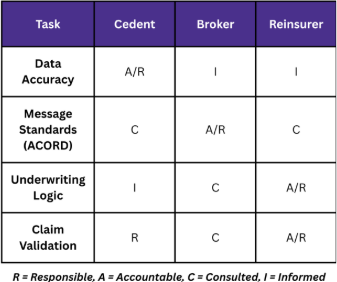
The interface is only as good as the payload. The Cedant owns the ‘truth’ of the risk. Even in a highly automated environment, the responsibility for data quality cannot be delegated to the machine. If the data is not in good order, the interface should reject it at the source and not end up cleaning it in the middle.
2. The Process Integrity Owner (The Broker)
In many digital ecosystems, the Broker owns the orchestration. They ensure the flow of information meets contract certainty and regulatory standards (such as ACORD GRLC). They don't own the risk, but they own the fidelity of the transmission.
3. The Decision Integrity Owner (The Reinsurer)
This is where it gets tricky. When a reinsurer uses an automated interface to auto-accept a risk based on pre-set parameters, they own the outcome. You cannot blame an automated system for a poor underwriting result. The reinsurer owns the logic inside the interface and is ultimately accountable to regulators and shareholders for the decisions it makes.
The Interface RACI
For reinsurers setting up new interfaces, have a look at this simplified RACI and stop that grey zone from expanding!
If you require any further support or information on ownership and decision rights, you know where to find me! We can chat about it anytime.